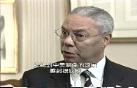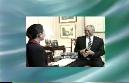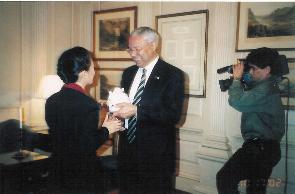
Interview with Secretary of State Colin Powell
U.S. State Department
October 17, 2002
|
|
|
|
|
|
|
|
||||||
|
||||||
|
||||||
Interview with Secretary of State Colin Powell |
||||||
|
||||||
Yeeli Hua Zheng: Mr. Secretary, it is our great honor and pleasure having you on our program today.
Sec. Powell: Thank you very much. It's good to be here
Yeeli Hua Zheng: Mr. Secretary, as you know Chinese President Jiang Zemin is going to meet with President Bush
at his private ranch in Crawford, Texas next week. What do you expect to be the concrete outcomes of this ranch
summit and how will it influence Sino-U.S relations in both the short and long term?
Sec. Powell: Well, let me say that the President is very much looking forward to receiving
President Jiang Zemin at Crawford next Friday, and I of course will be there too. Crawford is
a special place for the President. It's his home, it's his ranch. He only brings people there
who he considers friends, and he certainly considers President Jiang Zemin a friend. I think
the President is very pleased with the way U.S-Chinese relations have developed over the past 21 months of this
administration. The two leaders have met a number of times and I have stayed in very close contact with my
colleague in the Foreign Ministry, Foreign Minister Tang, and I talk to him on a regular basis. We have been able to
get through some difficult situations, like the reconnaissance plane incident last year. We got through that and put it
behind us, because we realize that U.S and China must work together. We are two important nations that want to
move forward together, to improve our economic relationship, to improve our cooperation on sensitive matters in the
region, regional stability, to discuss issues having to do with human rights, issues having to do with proliferation. I
think this will be an opportunity to forward that relationship. The two Presidents will focus on economic issues, on
cooperation issues, military to military cooperation and political cooperation. I am sure that they will also talk about the
regional situation, what is going on in North Korea right now. Obviously, they will also talk about Iraq. We stay in very
close touch with our Chinese colleagues because they are one of the permanent members of the Security Council.
We stay in close touch with China on the UN resolutions with respect to Iraq.
Yeeli Hua Zheng: Will President Bush try to persuade Chinese President Jiang to support the UN to take the next
step?
Sec. Powell: Well, I am sure he will have good conversation. Since that is still a week away, a lot will happen between
now and next week. I think we are seeing some movement now in the United Nations. We will see where we are next
week. But I am sure the President will convey to President Jiang Zemin our belief that Iraq is in violation of these
resolutions. The inspectors must go back in with the strongest possible inspection regime and that there must be
consequences if Iraq this time violates its obligations. I am sure they will talk about it. My impression is that the
Chinese understand these issues and the Chinese leadership understands these issues. I look forward to the two
leaders having a fruitful conversation.
Yeeli Hua Zheng: The events of 9/11 have made it very clear that Al Qaeda and terrorism are real enemies of the
United States; do you think that the war on terrorism will help reshape U.S perceptions of China, such that China will
not be seen as a potential threat or enemy but rather as a friend and ally?
Sec. Powell: We see China as a friend now, nobody in the administration sees China as an enemy. China is an
important country that is gaining newfound status in the world now that it's part of the World Trade Organization, now
that it is generating wealth because it is participating in the global economy. We want to work with China to help China
grow, to benefit all of the Chinese people - and not just those in urban areas but those in need who live in the other
parts of China. And so it is quite possible for our two nations with different political systems and different beliefs to
cooperate, to narrow differences, to support one another. And we don't see China as an enemy. Al Qaeda is not just
an enemy of the United States. As we saw in Bali, Indonesia a few days ago, Al Qaeda is an enemy of the world. Al
Qaeda can explode bombs in Indonesia, and can explode bombs in the United States. For that matter, if they thought
it would serve their purposes, they would explode bombs in China. China has its own concerns with organizations
that have terrorist links. We've cooperated with China. I must say that I have to express my appreciation and thanks
to all the support that the Chinese leadership and Chinese people have given to the United States since September
11 in 2001.
Yeeli Hua Zheng: Regarding Taiwan, isn't there an inherent contradiction between U.S support of the One China
Policy and its continued sale of advanced weaponry to Taiwan?
Sec. Powell: We are very much committed to our One China Policy, and President Bush will
reaffirm that again to President Jiang Ze Min, and with three communiqués that flowed from
our One China Policy position. But we also have a Taiwan Relations Act, that is United State's
law which requires that we make sure that Taiwan has the ability to provide for its defense.
But we are in no way doing anything that would tip the balance between the parties in the region. So we believe that
the Taiwan Relations Act and the weapon sales that we have from time to time with Taiwan are not at all inconsistent
with our One China Policy, and the commitments we have made to China. And I think the experience of the past
decades when we have lived under this policy bear that out. Our One China Policy goes back to the seventies, and
we have been able to structure a good relationship with China, and discharge the responsibilities that we have to
Taiwan.
Yeeli Hua Zheng: Regarding Iraq, U.S war plans and preparations are clearly under way, do you believe war with
Iraq is inevitable?
Sec. Powell: No, war is never inevitable. I'm a soldier and I studied war. War should never be seen as inevitable. We
should do everything to avoid war. And president Bush has said repeatedly that he wants to solve this peacefully, but
he has also said repeatedly that it must be solved. We cannot allow in this day 2002 for Iraq to continue to ignore the
will of the international community, for Iraq to develop weapons of mass destruction which could threaten the region,
and if they got into the hands of terrorists could threaten the world. So we will be firm looking for a peaceful solution,
but the only way we'll get a peaceful solution is if Iraq believes they will be compelled to obey if they don't obey
willingly.
Yeeli Hua Zheng: Mr. Secretary, you have been a very successful military man for most of your career, how has
your current position as a leader in the diplomatic arena changed you as a person, or your attitudes and
perspectives?
Sec. Powell: I think I'm the same person. I've tried never to change persons even though I changed jobs. I go at my
work as Secretary of State pretty much the same way I did as a soldier - someone who is trying to serve his country,
and now to serve the world, and to try to find the right answer to the difficult questions of the day, and to make sure
that in my work and the work of my colleagues in the Department of State and our embassies all around the world, we
try to be considerate of the views of other nations and other people. We don't try to impose our system, we show our
system to others because we think our system is a good one, and let others draw lessons from our system. I think I'm
someone who serves the nation, someone who shows the rest of the world that America seeks no enemies, only
seeks friends. We don't need any enemies, and we only want friends. Hopefully that value system is a value system
that more and more people will come to appreciate, and so I go about my job as Secretary of State the same way I
went about it as a soldier.
Yeeli Hua Zheng: Just one question on the top news of today. What is your reaction to North Korea's disclosure of
its nuclear development program?
Sec. Powell: Earlier this summer, we received information that suggested North Korea was violating their obligations
under the agreed framework and other agreements they had entered into by starting to enrich uranium. And we
studied it very carefully, we consulted with our Chinese colleagues, our Japanese colleagues, our South Korean
colleagues and our Russian colleagues, and then we reached out to North Korea. We told the North Koreans in
Pyongyang a couple of weeks ago that we wanted to have a better relationship, but they had to do something about
weapons of mass destruction and they had to do something about missiles. They had to do something about the sale
of this kind of technology, and we told them that we knew they were enriching uranium and this was simply
unacceptable. And to our great surprise…….
Yeeli Hua Zheng: Enriched uranium from which country?
Sec. Powell: Enriching uranium - I'd rather not get into where it comes from. But we made clear to them that they
violated agreements. And first they denied it, and then the next day, they came back and said "Yes, we are doing it".
And they took a very hard line position. Now I think it's appropriate for the United States to consult with all of its
friends in the region, and for all of us to give a straight, consistent message to North Korea that this kind of activity
must stop if you wish to normalize relations with friends in the region, potential friends in the region, and if you wish to
have the kind of assistance that the world can provide to you to help with your economic problems. You will not get
this kind of assistance, you will not move forward to a better life, if you continue to pursue this kind of weapons of
mass development.
Yeeli Hua Zheng: I believe that will offer new opportunities for the cooperation between China and the United States.
Sec. Powell: I am sure that this is another area where the United States and China will have a similar interest, and
that is to keep North Korea from becoming a nuclear power, and because of that similar interest, it gives us the
opportunity to cooperate.
Yeeli Hua Zheng: Before letting you go - I know the time is up - I just want to be sure that you are aware of ongoing
activities commemorating cooperation between American and Chinese pilots during World War II. There is an
exhibition in the Woodrow Wilson Center, and the Chinese delegation will pay their respects at the Arlington cemetery
tomorrow. Commemorating activities will also take place at President Bush's library. Could you please make a brief
comment on that?
Sec. Powell: I'm very pleased to hear about all of that, and it's good that we can look back after some difficult history,
and remember when there was unity between our two nations, and that these veterans have a chance to share their
experiences with one another, and that level of cooperation I hope will be the kind of cooperation that will exist in the
future between the United States and China.
Yeeli Hua Zheng: Thank you very much, Mr. Secretary.
Sec. Powell: Thank you.
Copyright © 2003 Yeeli Hua Zheng, All rights reserved.
All materials contained on this site are protected by United States copyright law and may not be reproduced, distributed, transmitted, displayed,
published or broadcast without the prior written permission of Yeeli Hua Zheng. You may not alter or remove any trademark, copyright or other notice
from copies of the content. You may download material from this web site (one machine readable copy and one print copy per page) for personal,
noncommercial use only.
 |  | | |
|