


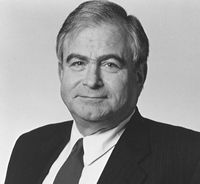
Interview with Mr. Sandy Berger
Former U.S. Secretary of Defense
October, 2002
Yeeli Hua Zheng: The events of September 11 have opened new opportunities for relations between the U.S and China. Do you think
that the war on terrorism has served as a major impetus for improved U.S-China ties?
Sec. Berger: In the first months of this administration, there was a tendency to look at China with more concerns and more worry than
we had had in the past. There is always a small group of ideologists seeing China as a future enemy. But after 9/11, Americans
discovered that we have a real enemy, Al Qaeda, and terrorism. We do not need to make enemies, we do not need to create enemies
out of friends. I think it had a very good effect of marginalizing those people, perhaps in this government, who want to focus in a negative
way on China, helping the administration realize terrorism is a global issue. There is no solution without China.
Yeeli Hua Zheng: How big is this negative and conservative force?
Sec. Berger: There is an anti-China element in the United States and there is an anti-American element in China. I think we should
strive to keep these views not in the center, but at the margins. There are some people in this government who have a more suspicious
view of China. After 9/11, on this issue, this is not a big factor. The importance of stability in this relationship is clearly understood by the
President, certainly by Secretary Powell. Iraq is an illuminating issue and there may be disagreement. But the fundamentals in the
relationship are strong because both the American and the Chinese government want a stable relationship, neither side really wants
too much trouble in this relationship.
Yeeli Hua Zheng: So the war on terrorism drives the two countries closer together?
Sec. Berger: Well, probably it has that effect. I think it helps put into perspective that we do not need to imagine enemies where we do
not have enemies; China is a friend of the United States. We disagree on certain issues, but fundamentally it is a positive relationship. I
think after September 11, U.S focusing on the war on terrorism helped shift the perceptions in a very constructive way.
Yeeli Hua Zheng: In President Bush's National Security Strategy report, it states that China and the U.S cooperate very well on the current
war on terrorism. Do you have a sense of the kind of anti-terrorism collaboration underway between China and the U.S?
Sec. Berger: I think there has been cooperation at both the high level and on the more working level in terms of sharing information.
Some groups in Central Asia are not only hostile to the US but also to China, so there are some overlapping interests. We are sharing
information on these groups and on other cooperative efforts. And also we make joint efforts to deal with the flow of global assets.
Yeeli Hua Zheng: Regarding the Taiwan issue, there are several possible outcomes. One is the reunification through peaceful means
or by use of force, the second is the maintenance of the status quo, and the third is Taiwan independence. Which one do you think
would be in the best interest of the U.S?
Sec. Berger: I believe very strongly in the One China Policy, that will be worked out by the government in Beijing and Taiwan peacefully. I
do not know whether political progress will be possible in the next year or so across the Strait. But it is important to focus on economic
progress. I think over time, when the economy of China and Taiwan become more interconnected, it will make peaceful political
resolution easier. It may be 2 years, 5 years or even 10 years. But the reality will be one integration. With more and more economic
integration, it will create a dynamic that over time will make political resolution of One China conceivable.
Yeeli Hua Zheng: One China and peaceful resolution; does that mean peaceful reunification?
Sec. Berger: I think the format will be something which will be acceptable to Beijing and also the people in Taiwan. But clearly, it has to
be in the framework of One China. But the actual words and language could evolve over time. I think vice premier Qian Qi Chen gave a
speech some months ago, which I think is very positive and creative in terms of how to think about the future. Given the political situation
at this point across the Strait, I don't see a lot of short term progress, though the political dialogue will resume. We have to avoid making
the situation worse on the political side while we see the economic relationship develop.
Yeeli Hua Zheng: What are U.S goals in its relationship with China? Overall, do you believe the U.S regards China as a potential ally, an
economic rival and strategic challenge, or some combination of each of these?
Sec. Berger: As you know, during the Clinton administration, President Clinton and President Jiang talked about the goal of strategic
partnership, not necessarily describing exactly what things are now, but where we should head for. I still believe we should head toward
the strategic partnership. I think that there are many areas that we only have begun to cooperate on. We have a relationship very much
dominated by trade, by proliferation, by human rights, and those are very important issues. But we can also begin to cooperate on
health, on environment, on a wide range of issues that two great countries have great impacts on both in China and throughout the
world. I think there is greater room for the expansion of the range of cooperation in other areas as we continue to work through the
issues we have. It is important that China's economic reform will succeed. To the success of the economic reform, over time it will be
political reform so that the rule of law is deeply ingrained. So if social tension arises, when China is going through all these changes, it
needs a vehicle for expression and for disputes to be resolved in a lawful and peaceful way. It is going to be evolution on the political
side as well as on the economic side. It will take place over time.
Yeeli Hua Zheng: On the economic side, the US has engaged a lot in China. Nowadays, there is increasingly more discussion in the
US, particularly in Congress, about political engagement in China through strengthening the rule of law; what are your views on such
political aspects?
Sec. Berger: I think it is important to look at it first of all from the perspective of China. I believe that China is undergoing the boldest
economic experiment in all of human history, which is to transform a country, which is poor, largely rural with a state-driven economic
system, into an increasingly middle class, more prosperous economy, that is driven more by the market. This is an historical
transformation. In the course of this transformation, there are going to be internal changes in China, as some people are dislocated and
others benefit. If China does not develop those legal institutions and political dialogue within China, the situation could be difficult for
China, because people have to have some way to defuse their frustration, their anxiety, their disputes within a structure, within a context;
otherwise the social cohesion will become stressed. I do not think this is something the U.S should impose on China. As I talk to
friends in China both in the private sector and from the government, I think they recognize that this evolution needs to take place for
China's benefit.
Yeeli Hua Zheng: Do you support U.S unilateral military action in Iraq?
Sec. Berger: I would prefer that not take place. We would be far more effective in Iraq together with the international community. One can
never rule out at some point if there is an immediate threat to the United States and the rest of the world does not support us, then we
have to act alone. I do not think we are at that point yet. Today we should be trying to build a coalition that is around us and not against
us.
Yeeli Hua Zheng: The Iraqi government has accused the Bush administration of seeking to control oil and politics in the Middle East
region. Is this what truly motivates the U.S to launch a war against Iraq?
Sec. Berger: I do not know what motivates them. I can not speak for the Bush administration and I am not a member of the Bush
administration. I can say that to the American people, it is not about oil. To the American people, their concern is with weapons of mass
destruction. They have seen the kind of destruction that can take place, terrorism on 9/11; they would not like to see that repeated with
chemical, biological or nuclear weapons. American people's concern is animated and motivated not by oil, but by having a less
dangerous situation.
Yeeli Hua Zheng: Even within the US, there are already some protests against the war. Do you believe the American anti-war sentiment
will rise?
Sec. Berger: I don't think Americans want a war. I think most Americans would prefer this to be resolved through collective action by the
international community pressuring Saddam Hussein and the Iraqi government to essentially get rid of these weapons. Most Americans
would prefer that outcome. But also there is a concern that if Saddam does not cooperate, that he has displayed a great deal of hostility
toward the U.S.
Yeeli Hua Zheng: Most would agree that war should be the last resort, not the first choice. What consequences will President Bush's
doctrine of preemptive strike bring about for world affairs?
Sec. Berger: Preemption is an option for any governments that have to face an imminent threat. I think it is a mistake for the US to
articulate this as a fundamental doctrine for its strategic policy. I think it is an option. As an option, every President preserves that option
in a situation where we are about to be attacked to act first. But to express this as the new doctrine of American foreign policy is
counterproductive. But it is written in the National Security Strategy. Well, I did not write the National Security Strategy this year. I try to
support the President and his administration as much as I can where I agree with them. But this is one place I disagree with them. I
thinks it says to the world that it provides pretext for others to act preemptively against their enemies. I think it lowers the threshold for
these weapons to be used because in times of tension, both sides may see a need for preemptive action. I think Iraq is a unique
situation; we have been in a conflict with Iraq for decades and it never really ended. I do not think that you need a doctrine to deal with
Iraq. I do not think US expressing a doctrine of preemption is in our long-term interest.
Yeeli Hua Zheng: May I conclude that such a doctrine is a destabilizing influence in Sino-US relations rather than a stabilizing one?
Sec. Berger: That is my whole view. We have seen the improvement in the bilateral relations after a period of harsh rhetoric and tense
confrontation. From the hard-line policy statement at the beginning of the Bush administration, to the collision between a U.S
reconnaissance plane and a Chinese fighter jet, to President Bush's two visits to China and right now President Jiang's upcoming visit
to U.S. President Bush invites President Jiang to come down to visit his private ranch. It is a symbol of the importance of the
relationship. It is a sign of the maturing of this administration's posture toward China over the last year. Clearly, as we confront the war
on terrorism, China is a very important partner of the United States. The anti-terrorism campaign represents new opportunity of
cooperation that can drive China and the U.S closer. However, such improvement does not constitute a fundamental strengthening and
stabilization of the relationship, because profound disagreements in other areas remain, and the biggest obstacle is the Taiwan issue.
Copyright © 2003 Yeeli Hua Zheng, All rights reserved.
All materials contained on this site are protected by United States copyright law and may not be reproduced, distributed, transmitted, displayed,
published or broadcast without the prior written permission of Yeeli Hua Zheng. You may not alter or remove any trademark, copyright or other notice
from copies of the content. You may download material from this web site (one machine readable copy and one print copy per page) for personal,
noncommercial use only.

